Children of Blood and Bone (The OrÏsha Legacy) (2018)
“Zélie Adebola remembers when the soil of Orïsha hummed with magic. Burners ignited flames, Tiders beckoned waves, and Zélie’s Reaper mother summoned forth souls.
But everything changed the night magic disappeared. Under the orders of a ruthless king, maji were killed, leaving Zélie without a mother and her people without hope.
Now Zélie has one chance to bring back magic and strike against the monarchy. With the help of a rogue princess, Zélie must outwit and outrun the crown prince, who is hell-bent on eradicating magic for good.
Danger lurks in Orïsha, where snow leoponaires prowl and vengeful spirits wait in the waters. Yet the greatest danger may be Zélie herself as she struggles to control her powers―and her growing feelings for an enemy.”
Tomi Adeyemi is a Nigerian-American writer and creative writing coach based in San Diego, California. After graduating Harvard University with an honors degree in English literature, she studied West African mythology and culture in Salvador, Brazil. Visit her at tomiadeyemi.com. Follow her @tomi_adeyemi
I work in a public library and there are times a book comes through circulation that is so awesome I can’t believe I hadn’t seen it before.
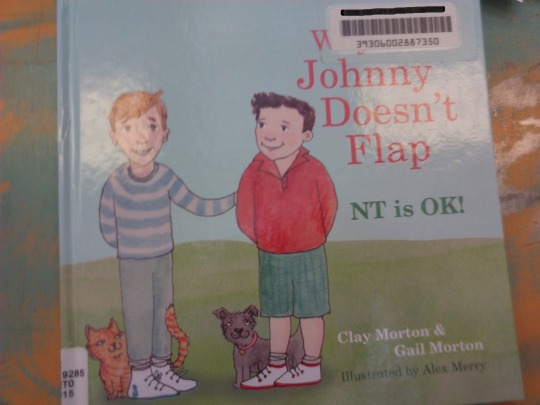
Last week I came across this lovely children’s picture book called Why Johnny Doesn’t Flap: NT is OK! by Clay Morton, Gail Morton, and illustrated by Alex Merry. (Pardon the library barcode covering part of the title here.)
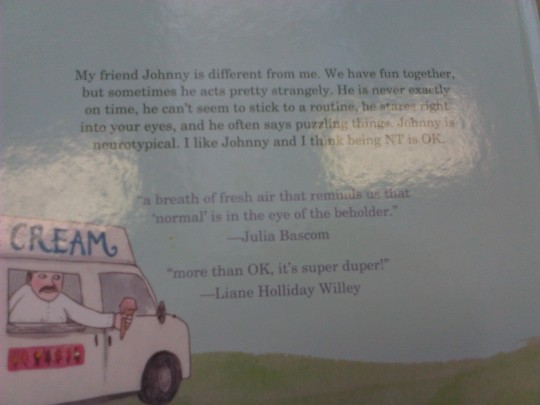
[Pictures of the front and back covers of the picture book. The back cover summary says: “My friend Johnny is different from me. We have fun together, but sometimes he acts pretty strangely. He is never exactly on time, he can;t seem to strict to a routine, he stares right into your eyes, and he often says puzzling things. Johnny is neurotypical. I like Johnny and I think being NT is OK.”]
The fact that I was seeing the term “NT” on the cover of a children’s book was enough to pique my interest. Upon further inspection, I discovered that the book is really quite lovely!
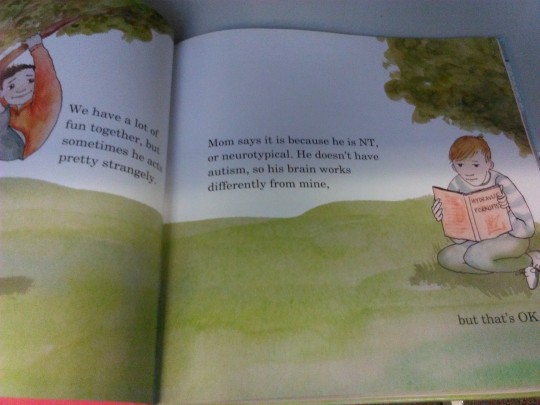
[Two page spread reads: “We have a lot of fun together, but sometimes he acts pretty strangely. Mom says it is because he is NT, or neurotypical. He doesn’t have autism, so his brain works differently from mine, but that’s OK.”]
It flips the typical “little Timmy has a special friend” narrative on its head. Instead, the narrator is an autistic boy who has an NT friend who he sometimes struggles to understand.
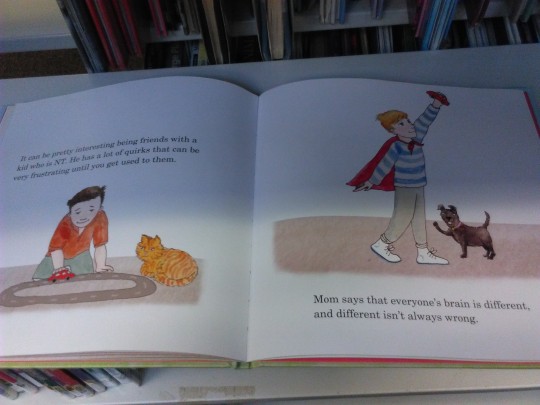
[Two page spread reads: It can be pretty interesting being friends with a kid who is NT. He has a lot of quirks that can be very frustrating until you get used to them. Mom says that everyone’s brain is different and different isn’t always wrong.”]
The book uses simple terms to describe a perspective not usually seen in any literature, let alone lit intended for children.
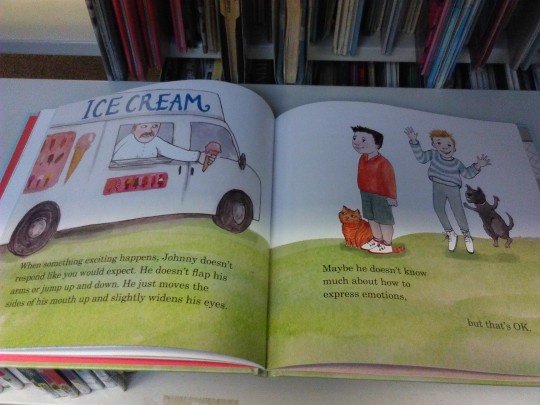
[Two page spread reads: “When something exciting happens, Johnny doesn’t respond like you would expect. He doesn’t flap his arms or jump up and down. He just moves the sides of his mouth up and slightly widens his eyes. Maybe he doesn’t know much about how to express emotions.”]
I think ultimately this flipping of the narrative is more effective in getting the message across that kids with autism are just like everyone else but with unique needs.
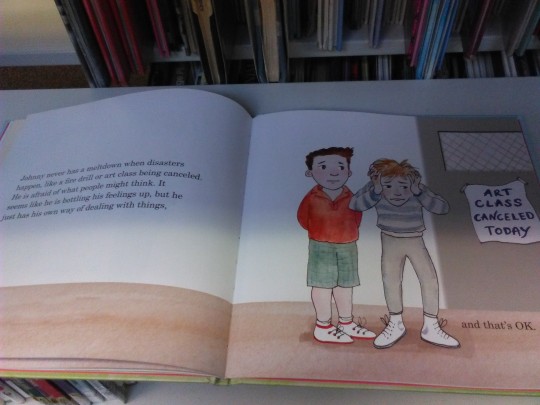
[Two page spread reads: “Johnny never has a meltdown when disasters happen, like a fire drill or art class being canceled. He is afraid of what people might think. It seems like he is bottling his feelings up, but he just has his own way of dealing with things, and that’s OK.”]
And this book is something autistic kids don’t usually have– it’s a book from their perspective! And it’s a non-offensive, matter-of-fact perspective, which is all the rarer.
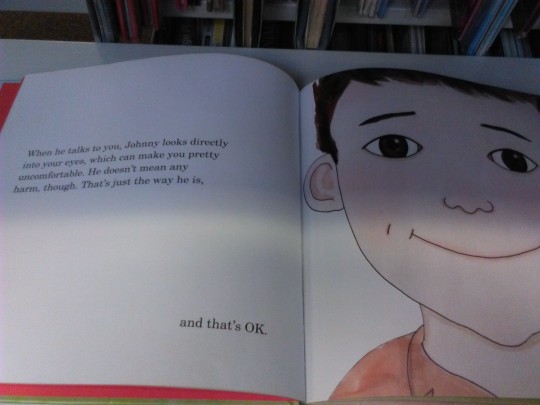
[Two pages spread reads: “When he talks to you, Johnny looks directly into your eyes, which can make you pretty uncomfortable. He doesn’t mean any harm, though. That’s just the way he is, and that’s OK.”]
It talks about things that autistic people experience and can relate to.
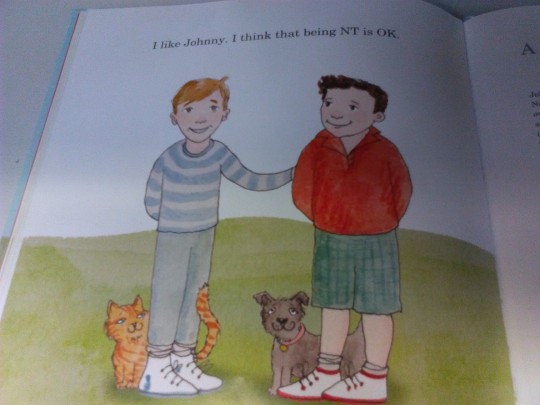
[Page reads: “I like Johnny. I think that being NT is OK.”]
How awesome is that?
A book like this would have been so beneficial to me as a kid to help me not feel alien. If you want autistic people to relate to others in fiction, we need stories from our point of view too.
I NEED THIS BOOK
I love that it flips the narrative, that’s so clever.
Enchanting Bookworm Inspired Digital Illustrations by Simini Blocker
NYC based illustrator Simini Blocker understands the enchanting world bookworms revel in. From Hogwarts to Neverland or King’s Landing, Blocker captures the spellbinding imaginative realms literature has introduced to us with vibrant colours, gorgeous brushstrokes and fitting quotes from our favourite authors. You can find her gorgeous illustrations on Society6 and Etsy.
ok so i know love simon comes out really soon and all but you know what else comes out soon (on april 24th)? simon’s sequel from leah’s point of view where she’s going to come out as bi and maybe even get a love interest and ppl are missing out on this!
it’s going to be called leah on the offbeat and this is the full synopsis for it and its cover:
When it comes to drumming, Leah Burke is usually on beat—but real life isn’t always so rhythmic. She’s an anomaly in her friend group: the only child of a young, single mom, and her life is decidedly less privileged. She loves to draw but is too self-conscious to show it. And even though her mom knows she’s bisexual, she hasn’t worked up the nerve to tell her friends—not even her openly gay BFF, Simon. So Leah really doesn’t know what to do when her rock-solid friend group starts to fracture in unexpected ways. With prom and college on the horizon, tensions are running high. It’s hard for Leah to strike the right note while the people she loves are fighting—especially when she realizes she might love one of them more than she ever intended.


 SliceOSunshine