File this under “super obvious yet I always seem to forget it.”
I don’t write romance (I totally respect people who do, though!) but this is also great writing advice in general! What is preventing the protagonist from achieving their goal?
Why can’t these two people be together now?
Why can’t the mystery be solved now?
Why can’t they overthrow the evil overlord now?
If you don’t have a solid answer for these questions, that’s a good indicator that the plot could use some more work.
Also test your answer a little bit. If it’s as thin as they’re just refusing to sit down and have a simple conversation, you might want to re-think how things are going.
As a beta reader/editor, I tend to ask this question a lot: “Why are they doing it this way when there’s a much easier path available?” That’s not to say that they should take the easier path, because that would usually be boring. Instead, the point is that the question needs an answer–either eliminate the easier path or give them a very clear reason for not taking it. (And if I’m asking the question, that reason isn’t as clear as you think it might be.)
I find it very difficult to root for characters who have a sensible option available and just don’t take it. If the only reason is “Because there wouldn’t be a story otherwise,” you haven’t actually found the story yet.
writing conclusions in papers is like the stupidest thing ever though like what’s the point of dedicating an entire paragraph to “so yeah i know you just read my paper but this is a summarization of what you read in case you need to be reminded about what you just read” like why can’t the paper just end
I keep seeing this post and similar ones, and if y’all’s teachers and professors have left you with the idea that a conclusion is a summary, they have failed you in a big way.
Your conclusion is your “so what’s the fucking point” section. You’ve given you’re reader a lot of info and now they need to know why they care. Depending on the type of paper you should be giving a plan of action, explaining how this knowledge changes our understanding of the topic, link your paper to other disciplines, suggest further areas of study, etc.
One of the best pieces of writing advice I’ve ever received is that if you can’t envision yourself dropping the mic and strutting off stage at the end of your conclusion then it’s probably not strong enough.
things english speakers know, but don’t know we know.
WOAH WHAT?
That is profound. I noticed this by accident when asked about adjectives by a Japanese student. She translated something from Japanese like “Brown big cat” and I corrected her. When she asked me why, I bluescreened.
things english speakers know, but don’t know we know.
WOAH WHAT?
That is profound. I noticed this by accident when asked about adjectives by a Japanese student. She translated something from Japanese like “Brown big cat” and I corrected her. When she asked me why, I bluescreened.
As for “Write what you know,” I was regularly told this as a beginner. I think it’s a very good rule and have always obeyed it. I write about imaginary countries, alien societies on other planets, dragons, wizards, the Napa Valley in 22002. I know these things. I know them better than anybody else possibly could, so it’s my duty to testify about them.
Realizing it’s not romance that I hate but overdone straight relationships with zero chemistry built on a slew of misogynistic tropes was like a huge revelation for me
I have a story about this.
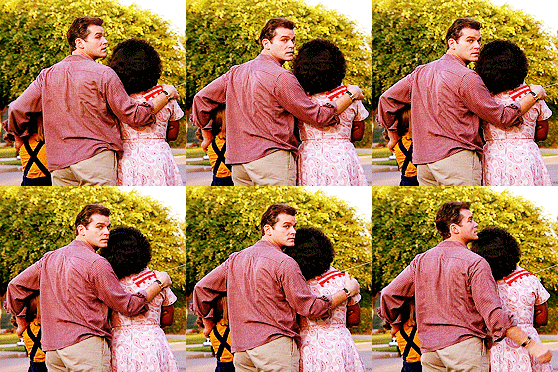
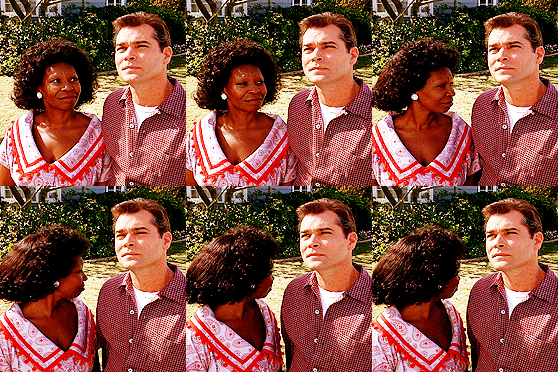
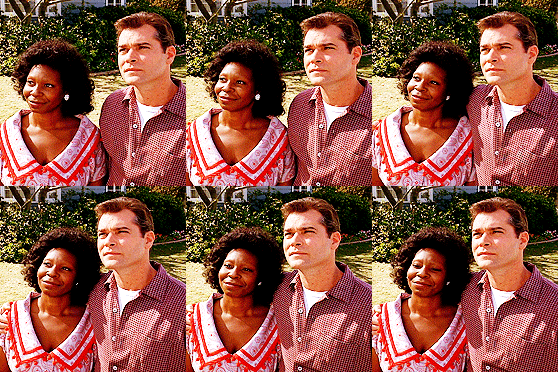
My revelation regarding this was spurred by a little-known film that actually didn’t do very well in theatres at all, from the early 90s called Corina Corina.
Starring heartthrob of the time Ray Liotta, fresh off his Goodfellas fame and…..Whoopie Goldberg??? as his love interest??????
Bear with me here.
Corina Corina is the story about a man whose wife died, leaving him alone to parent his 8-9 year old daughter alone in what appears to be the late 50s-early 60s. His daughter, Molly, is non-verbal due to the trauma of her mother’s death and is dealing with feelings of isolation as a result of her mourning process. Ray Liotta’s character makes a concentrated effort to be a good dad for her, but it’s real clear that both of them are still dealing with the death of his wife. Because Ray’s character works full time, he needs to find a nanny to watch his girl and pick her up from school. After a couple of terrible experiences (one with a hilarious appearance by Joan Cusack) he decides to hire Whoopie Goldberg.
Whoopie Goldberg’s character is a college educated black woman (in the 50s!!!!) who appears to be doing domestic work because its the only work white 50s America will hire her for. She and Ray’s daughter Molly get along well because she is the first person to take Molly’s decision to be non-verbal seriously and learn an alternate way to communicate with her.
Long story short, Whoopie Goldberg and Ray Liotta fall in love and live happily ever after.
But, more importantly, the way the movie built their love changed the way I was able to process hetero couples on screen forever.
1. First, they were both provided with alternate romance options from the beginning of the movie. Ray was given an extremely attractive white lady love interest, and Whoopie was given an attractive and charming black man love interest. Both of them were given opportunities to return their affection but both pointedly chose not to.
2. They were attracted to each other based on common interest. They both liked the same music, they both bonded over their ability to play the piano, they both loved molly, they both helped encourage each other in their chosen fields (whoopie’s was english, and ray’s was being a songwriter), they both respected each other’s opinions and they both were honest with each other about the circumstances they were in.
3. They were realistic about the issue of a black woman being in a relationship with a white man in the era, and didn’t glide over racial identity issues. Ray made sure that his white neighbors knew that he loved her and didn’t care what they thought. He even explained to his mom that Molly emulating black culture wasn’t shameful and that she should mind her business about the way he felt about Whoopie Goldberg.
4. When Ray confessed his feelings, it was incredibly heartfelt and he was literally crying.
5. They didn’t pursue a romantic relationship until Whoopie wasn’t working for him anymore. And they didn’t gloss over the issue of power disparity in that equation. Ray doesn’t condescend to Whoopie at all through the movie, but once he’s aware he has feelings for her, his new goal is to let her know that he unquestionably considers her his equal both in private and in public And its clear that he’s aware that this is the first thing that must be settled before anything else.
By the time you get to the end of the movie, the entire concept of Ray Liotta being with Whoopie Goldberg seems not only normal, but exceptionally romantic and you’re left wondering why you thought they would be a gross couple to begin with when they’re sO cLeArLy MaDe fOr eAcH oThEr
I now call this the Corina Corina standard.
If a movie has a hetero couple and their relationship isn’t as fleshed out as Ray/Whoopie, I now have difficulty accepting whats occurring.
The concept that two hot straight people who are vaguely near each other just doesn’t do it for me anymore after watching Ray Liotta walk through a black neighborhood in the 50s and knock on Whoopie’s door to beg her to come home to him.

 SliceOSunshine